Self-reflection x GenAI as the medium to awe
Our latest paper is now out in Empirical Studies of the Arts - Designing for Aesthetic Awe: Self-Transcendent Experiences with Generative AI and Augmented Self-Reflection
It looks at how aesthetic awe can be elicited with generative AI, using an interactive system where your self-reflection is continuously augmented in real time.
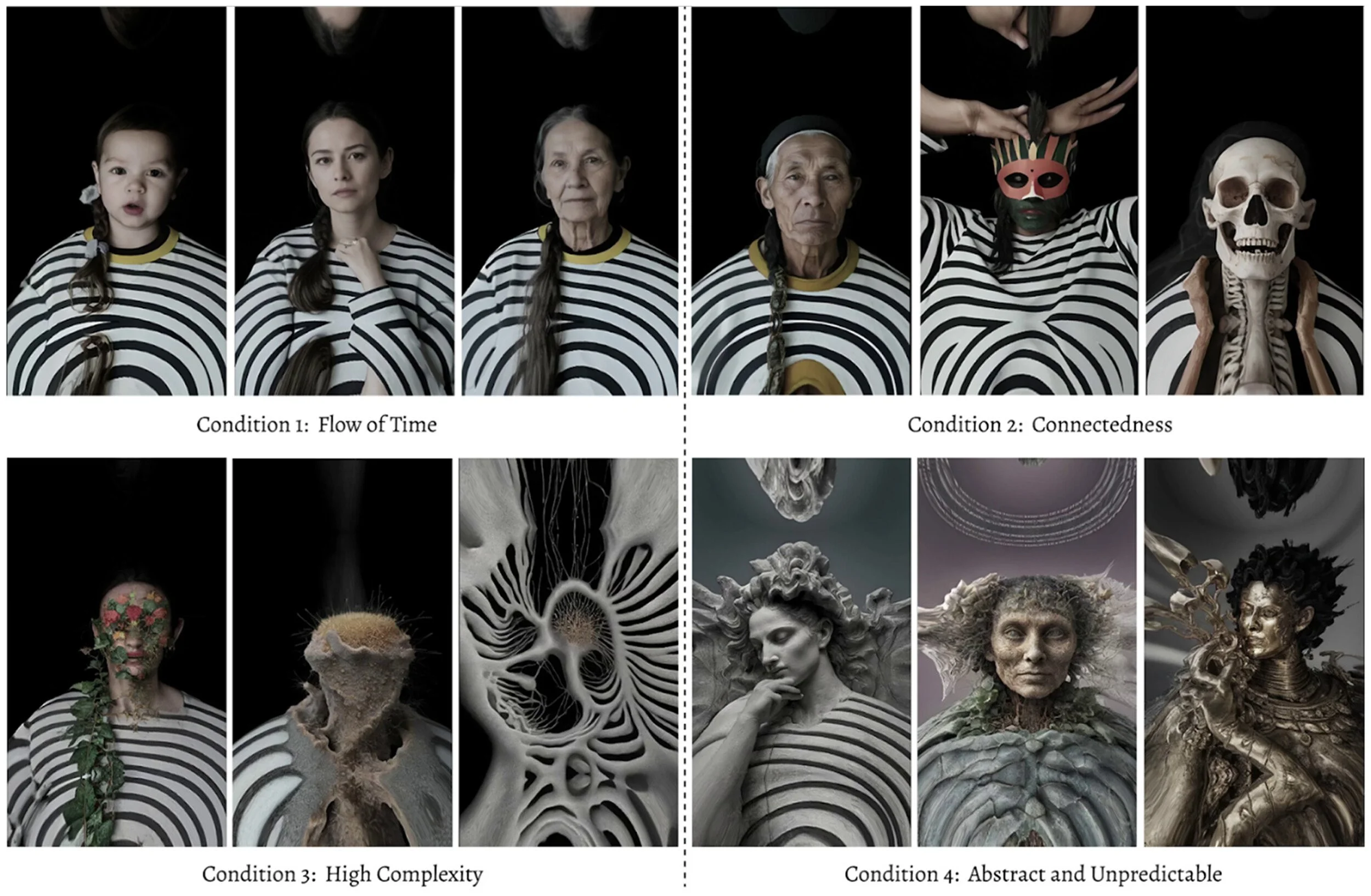
We employed four scenarios to elicit awe (Looking Glass), designed based on prior literature. Through a controlled study in Riga and Tampere, we collected both quantitative and qualitative data and explored the relationship between personality traits, self-immersion (measured via other-in-self), experience of awe, and the four design conditions. This implementation is uniquely enabled by GenAI and is a great example of human-media enmeshment. When the self starts to shift across time, into archetypal forms, or into something more abstract, the experience does not sit comfortably as either “you” or “something else” (i.e. subject vs object).
Across the study, different aesthetic strategies produced different configurations of this relation. More recognisable transformations, particularly retaining the anthropomorphic nature, tended to sustain continuity with oneself, grounding the experience in connection and personal meaning. More abstract and unstable transformations displaced this continuity, leading to experiences shaped by vastness, unpredictability, and perceptual reorientation.
A key factor throughout was the degree to which participants recognised themselves in what they were seeing. When this “other-in-self” relation held strongly, the experience intensified. On the other hand, when the experience lost some of that grounding it still often remained powerful, drawing instead on feelings of vastness, complexity, and uncertainty. In the study, we thus recognised two distinct experiential pathways to awe — Connection-driven, and Vastness-driven, respectively.
Additionally, individual traits, and in particular self-transcendence, engagement with beauty, and neuroticism, played a noticeable role in how strongly awe was experienced. This points to a more situated view of these interactions, where the experience, expectedly, emerges from the interaction of the user and the media, warranting more research on the topic.
Overall, the work points to how GenAI can be used in creative and compelling ways while bridging the gap between who we are and what we see, opening new opportunities for meaningful and enriching experiences.
—————
Peters, J., Bujić, M., Roihankorpi, R., & Hamari, J. (2026). Designing for Aesthetic Awe: Self-Transcendent Experiences with Generative AI and Augmented Self-Reflection. Empirical Studies of the Arts. SAGE.
DOI: https://doi.org/10.1177/02762374261437049
Authors: Jurgis Peters, Mila Bujić, Riku Roihankorpi, and Juho Hamari.
Funding: This work was supported by the research infrastructure at Tampere University: NEXUS - Research Infrastructure for Interaction Between Humans, Technology, and Society. In particular, essential equipment, premises and support was provided through the Ludus laboratory inventory and staff. The study was supported by Jane and Aatos Erkko Foundation through CONVERGENCE of Humans and Machines project at Tampere University, Finland; Research Council of Finland (342144; ‘POSTEMOTION’; 337653, UNITE Flagship); and Kone Foundation (DIAL: 202008478).
