Our latest paper is now out in International Journal of Human-Computer Studies - Designing the future of consciousness: A components framework and speculative implications!
Science fiction has long been a space of inspiration, exploration, anticipation, and critique — I can imagine many of us in HCI and emerging media and technologies were significantly shaped by our sci-fi experience; I certainly was! So, why not use it to open new perspectives and help us anticipate and steer sustainable design directions?
In our new paper, we use this anticipatory potential of science fiction to explore the possible futures of digitally induced altered states of consciousness (DIAL): technologies that use digital means to induce or control changes in perception, cognition, emotion, or other aspects of conscious experience. This is the first of a small series of papers on the topic - stay tuned!.
We analysed 25 science fiction novels, ranging from The Stars My Destination and Ubik to Neuromancer, Snow Crash, Altered Carbon, and A Memory Called Empire. Across these fictional worlds, we examined technologies that alter consciousness through artificial memories, altered emotions, dream states, changed perceptions of time, shared experiences, neural interfaces, and technologically mediated identities. We constructed a design framework as well aswhat kinds of interactions and societies they could bring forth — and ultimately what implications can we discern for today as well as the future.
The framework is organised around two core questions - a) What is the context of the alteration, and b) What is its purpose?
The context can be internal, where the altered experience remains within one person, or external, where another person or system is involved. The purpose can broadly involve exploration (acquiring or changing knowledge and experience) or communication (transmitting or exchanging information and experience). Combining these dimensions and their subcategories produced eight different types of interaction with digitally altered consciousness.
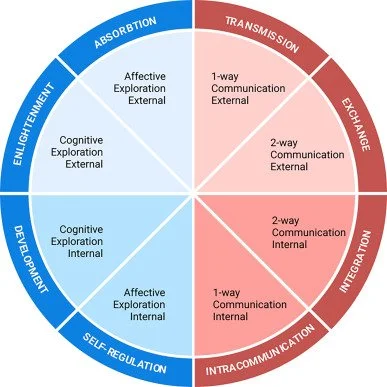
Beyond individual fictional technologies, we identified recurring ideas across different contexts and purposes.
One is the relationship between technology, time, cognition, and productivity. Science fiction frequently imagines technologies that allow people to extend subjective time, acquire skills through artificial memories, or continue learning while asleep. These can initially look like ways of overcoming human limitations, but the stories often anticipate a less liberating development; once everybody can do more, doing more simply becomes the new expectation, which sounds oddly familiar in today’s AI landscape. Technologies designed to free people from cognitive or temporal limitations can therefore reinforce the same competitive pressures they appeared to solve.
Another recurring issue is transformation of the self. Technologies that modify memories, emotional responses, personality, or perspective can support learning, creativity, empathy, and personal development. However, at the same time, the imaginaries often represent the tensions between development and well-being on side, and imposed transformation on the other.
And, naturally, new technologies are rarely used only for productive or therapeutic purposes. Our third theme—New Sex, Drugs, and Rock & Roll—looks at fictional technologies for technologically programmable pleasure, entertainment, stimulation, and altered experience. Here, familiar practices do not disappear with technological development but take new forms of producing, intensifying, recording, transmitting, and consuming them.
The stories also repeatedly anticipate technologies that make truth and reality increasingly negotiable. The ability to alter perception, memories, emotions, or beliefs can have therapeutic applications, but the same capacities can be used for advertising, behavioural influence, political control, or other forms of manipulation.
Finally, many of these imagined technologies eventually lead to a much older science-fiction question: what does it mean to remain human as technology increasingly becomes part of the processes through which we think, feel, remember, and experience ourselves? Across the novels, the boundaries of the self can be expanded, protected, fragmented, merged, or dissolved through technologically induced altered states. For us, this is where science fiction becomes particularly valuable and interesting for research on emerging technologies. It offers us a library of technological imaginaries in which inventions have already been placed into social contexts and followed to some of their possible consequences.
And as technologies increasingly begin to interact directly with our cognitive and affective states, some of those once-fictional questions are becoming considerably less fictional.
—————
Belousov, A., Macey, J., Bujić, M., Ojell-Järventausta, T., & Hamari, J. (2026). Designing the Future of Consciousness: A Components Framework and Speculative Implications. International Journal of Human-Computer Studies, 103926.
DOI: https://doi.org/10.1016/j.ijhcs.2026.103926
Authors: Anatolii Belousov, Terho Ojell-Järventausta, Joseph Macey, Mila Bujić, Juho Hamari
Funding: This work is supported by Kone Foundation [DIAL: 02008478] and the Research Council of Finland [Postemotion: 342144; Centre of Excellence in Game Cultures: 353268; UNITE: 337653, 359173; CLIMETA: 377217].
